Running a restaurant is about more than serving great food. You also need to attract new customers, build trust, manage reservations, increase orders, and keep your business visible online.
For many customers, the first interaction with a restaurant happens online. They may search for your restaurant, check your menu, look at food photos, read reviews, find your location, or check whether they can book a table or order online.
This makes your website an important part of your restaurant business.
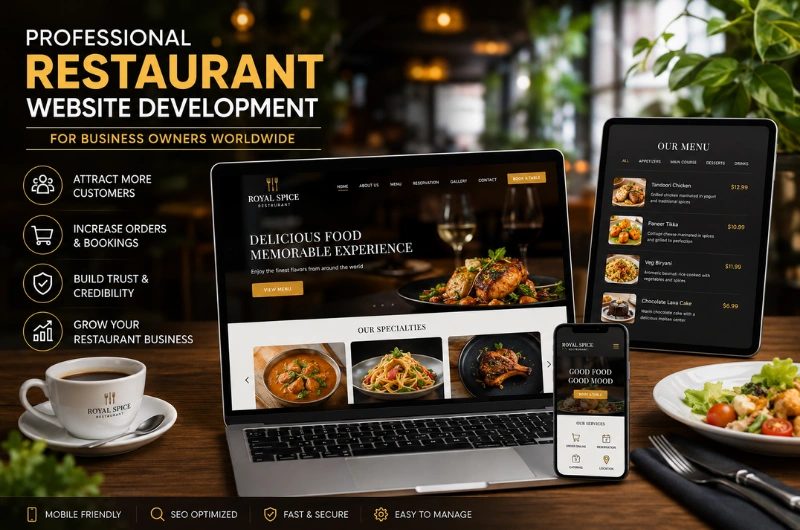
Professional restaurant website development helps business owners create a website that works as a digital storefront, marketing tool, customer service channel, and sales platform.
Whether you own a Nepali restaurant in Kathmandu, an Indian restaurant in Denver, a Thai restaurant in Sydney, or a restaurant serving any other cuisine anywhere in the world, your website should make it easy for customers to discover your business and take action.
At Webtech Nepal, we develop professional business websites with a focus on clear design, mobile usability, performance, SEO, security, and practical business goals.
What Is Restaurant Website Development?
Restaurant website development is the process of planning, designing, developing, testing, launching, and maintaining a website specifically for a restaurant or food business.
A restaurant website is different from a basic business website because customers often need access to food menus, ordering systems, reservations, locations, opening hours, and other restaurant-specific information.
Depending on the business, a restaurant website may include:
- Online food menu
- Food and restaurant photography
- Online ordering
- Table reservations
- Delivery information
- Pickup options
- Restaurant locations
- Opening hours
- Customer reviews
- Events
- Catering information
- Contact forms
- Online payments
- Multiple languages
- Social media integration
- Local SEO
- Google Maps integration
The main goal is simple: help customers find your restaurant, understand what you offer, trust your business, and take the next step.
That next step could be ordering food, booking a table, calling your restaurant, getting directions, requesting catering information, or visiting your location.
For a restaurant business owner, a professional website should not simply look attractive. It should support real business goals.
Why Do Restaurant Business Owners Need a Professional Website?
Many restaurant owners already use social media, food delivery platforms, and online business directories.
These platforms can be useful, but they should not be your only online presence.
A website gives you a digital home that your business controls.
You decide what information customers see, how your brand is presented, what services are promoted, and which actions customers can take.
A professional restaurant website can help business owners:
- Attract new customers
- Increase online visibility
- Display the complete menu
- Generate online orders
- Accept table reservations
- Build customer trust
- Promote special offers
- Support local SEO
- Showcase the restaurant brand
- Generate catering leads
- Promote events
- Support multiple locations
- Provide important business information 24/7
Your website can also serve customers outside your restaurant’s opening hours.
Someone can check your menu before breakfast, make a reservation late at night, or look for your location while traveling.
Four Business Goals a Restaurant Website Can Support
A restaurant website should support more than one goal. For most business owners, four goals matter most.
| Business Goal | How a Website Helps |
|---|---|
| Attract more customers | SEO, local search, useful content, and strong design |
| Increase orders and bookings | Online ordering and reservation features |
| Build trust | Reviews, menu, photos, contact details, and business information |
| Grow the business | SEO, marketing, promotions, catering, and lead generation |
The exact priorities will depend on your restaurant.
A takeaway business may focus heavily on online orders. A fine-dining restaurant may focus more on reservations and brand presentation. A catering business may need more inquiry forms and event information.
The website should be built around those priorities.
Restaurant Website Development for Any Cuisine and Business Type
A professional restaurant website should represent your business rather than follow a one-size-fits-all template.
A fine-dining restaurant needs a different online experience from a fast-food takeaway business.
A small cafe has different needs from a restaurant group with locations in several countries.
Restaurant website development can support businesses such as:
- Nepali restaurants
- Indian restaurants
- Chinese restaurants
- Italian restaurants
- Japanese restaurants
- Korean restaurants
- Thai restaurants
- Mexican restaurants
- American restaurants
- Mediterranean restaurants
- Vegan restaurants
- Vegetarian restaurants
- Cafes
- Bakeries
- Food trucks
- Fast-food restaurants
- Fine-dining restaurants
- Takeaway businesses
- Catering companies
- Restaurant groups
The cuisine does not determine the technology.
Your business model, target customers, location, services, and business goals should determine the website structure and features.
Key Features of a Professional Restaurant Website
A restaurant website should make important information easy to find.
Business owners should think about what customers need before they decide to visit or order.
1. Professional Restaurant Homepage
Your homepage is often the first page customers see.
It should quickly communicate:
- Restaurant name
- Cuisine
- Location
- Main dishes
- Brand personality
- Ordering options
- Reservation options
- Opening hours
Use clear calls to action such as:
View Menu | Order Online | Book a Table | Get Directions
The homepage should not be overloaded with information.
Strong food photography, short sections, useful information, and clear buttons can help customers understand your restaurant quickly.
2. Mobile-Friendly Restaurant Website Design
A restaurant website must work well on smartphones.
Customers often search for restaurants while they are away from home. They may be walking through a city, planning dinner, traveling, or looking for a quick takeaway.
A mobile-friendly website should make it easy to:
- Open the menu
- Read food descriptions
- View prices
- Call the restaurant
- Get directions
- Place an order
- Reserve a table
- Submit an inquiry
Buttons should be easy to tap. Text should be readable. Images should fit the screen properly.
Mobile usability should be considered from the beginning of the development process.
3. Digital Restaurant Menu
The menu is one of the most important parts of a restaurant website.
Customers want to know what you serve before deciding whether to visit or order.
A useful online menu can include:
- Food name
- Food description
- Price
- Ingredients
- Food images
- Vegetarian labels
- Vegan labels
- Spice levels
- Allergen information
- Portion information
- Special dishes
Avoid relying only on a PDF menu.
A web-based menu is usually easier to read on mobile devices. It also makes it easier for business owners and staff to update prices, dishes, and availability.
4. Online Food Ordering
If your restaurant provides delivery or takeaway, online ordering can create a direct path from your website to a purchase.
A typical ordering process looks like this:
- Customer visits your website.
- Customer views the menu.
- Customer selects food.
- Items are added to the cart.
- Customer chooses pickup or delivery.
- Customer provides the required information.
- Payment is completed where supported.
- Order is confirmed.
Your website can provide its own ordering system or connect customers to an existing third-party ordering platform.
The right solution depends on your restaurant’s location, delivery process, payment provider, and existing restaurant software.
5. Online Table Reservation
Restaurants that accept bookings can add an online reservation system.
Customers may select:
- Date
- Time
- Number of guests
- Name
- Phone number
- Special requests
The Book a Table button should be easy to find.
Business owners should also make sure the reservation process works properly on mobile devices.
6. Restaurant Location and Google Maps
Customers should never have to search for your address.
Your website should clearly show:
- Full address
- City and country
- Opening hours
- Phone number
- Map
- Parking information
- Transportation information where useful
For restaurants with multiple branches, each location should have accurate information.
Dedicated location pages can also support local search visibility.
7. Food Photography and Restaurant Gallery
Food photography plays an important role in restaurant marketing.
Use high-quality images of:
- Signature dishes
- Popular menu items
- Restaurant interior
- Exterior
- Dining area
- Chef
- Staff
- Events
Images should represent your real restaurant and food.
At the same time, large image files should be optimized so they do not slow down your website.
8. Customer Reviews and Testimonials
Trust matters when people choose where to eat.
Genuine reviews and testimonials can help potential customers understand the experience they may receive.
Business owners can highlight selected customer feedback on their website and connect visitors to relevant review platforms.
Never publish fake reviews or misleading testimonials.
9. Catering and Event Information
Restaurants often have opportunities beyond normal dining.
Your website can promote:
- Wedding catering
- Corporate catering
- Birthday parties
- Private dining
- Business lunches
- Group events
- Special celebrations
If catering or events are an important part of your business, consider creating a dedicated page for these services.
This can help potential customers understand what you offer and submit inquiries directly.
10. Contact Forms
A contact form can handle questions that do not fit into ordering or reservations.
For example:
- Catering requests
- Private event inquiries
- Partnership requests
- Group bookings
- Dietary questions
- General inquiries
Keep forms short and ask only for information your team needs.
Restaurant Website Design That Helps Business Growth
Restaurant website design should balance appearance with usability.
A beautiful website is useful only when customers can easily find information and take action.
A good restaurant website should have:
- Clear navigation
- Strong food photography
- Readable typography
- Consistent branding
- Clear calls to action
- Mobile-friendly layouts
- Fast-loading pages
- Simple menus
- Easy-to-find contact information
Match the Website With Your Restaurant Brand
Your website should feel like your restaurant.
For example:
A fine-dining restaurant may use an elegant layout and large food photography.
A family restaurant may use a warm and welcoming design.
A modern cafe may use a clean design with strong visual elements.
A fast-food restaurant may prioritize online ordering and delivery.
The website should create an online experience that matches what customers can expect when they visit your physical restaurant.
Restaurant SEO: Help Customers Find Your Business
A professional restaurant website needs visibility.
Restaurant SEO helps your website appear when people search for restaurants, cuisines, dishes, and dining services.
Potential searches may include:
- Indian restaurant in London
- Nepali restaurant in Sydney
- Indian food near me
- Best Nepali food in Kathmandu
- Vegan restaurant in Toronto
- Italian restaurant in Dubai
- Restaurant open near me
- Takeaway restaurant near me
The right keywords depend on your location, cuisine, menu, services, and target customers.
Local SEO for Restaurant Business Owners
If you operate a physical restaurant, local SEO can be especially valuable.
Your website should clearly communicate:
- Restaurant name
- Address
- City
- Country
- Cuisine
- Opening hours
- Phone number
- Service area
Business owners should also keep their information accurate across important local business platforms.
Do not add locations or keywords that do not represent your actual business.
Search optimization works best when it reflects the real services and locations you provide.
Optimize Individual Restaurant Pages
Your homepage should not be responsible for every search query.
Depending on your business, useful pages may include:
- Restaurant homepage
- Menu page
- About page
- Catering page
- Locations page
- Individual location pages
- Private dining page
- Events page
- Contact page
Each page should have a clear purpose.
For a multi-location restaurant, individual location pages can provide customers with accurate information about each branch.
How Restaurant Website Development Supports Online Orders
A restaurant website can become an important sales channel when ordering is simple.
Imagine a customer searches for:
“Indian takeaway near me.”
They visit your website and immediately see:
- Restaurant name
- Food photos
- Menu
- Prices
- Opening hours
- Delivery information
- Order button
The customer can move from search to purchase without unnecessary steps.
Make the Ordering Process Simple
A good ordering experience should make it easy to:
- Browse food categories
- Select items
- Customize food when needed
- Review the cart
- Select delivery or pickup
- Enter contact details
- Pay where supported
- Receive confirmation
Business owners should test the complete ordering process on smartphones before launching the website.
A complicated checkout process can cause customers to abandon their orders.
Restaurant Website Development for Table Reservations
Online reservations can make it easier for customers to book a table without calling your restaurant.
A customer may discover your restaurant through Google, social media, or another channel and visit your website to make a booking.
Make the process simple.
Place reservation buttons in visible areas such as:
- Homepage
- Menu page
- Header
- Contact page
- Location page
If you use a third-party booking platform, make sure the booking option is still easy to access from your website.
Restaurant Website Development for Multiple Locations
Restaurant groups have different requirements from single-location businesses.
A multi-location website may need:
- Location directory
- Individual branch pages
- Separate addresses
- Separate opening hours
- Branch-specific phone numbers
- Location-specific menus
- Reservation options
- Delivery areas
- Local SEO
For example:
Restaurant Name
→ Kathmandu → London → Sydney → Melbourne
Each location can have its own page with accurate information.
This structure helps customers find the correct branch and can create additional opportunities for location-based search visibility.
Multilingual Restaurant Websites for International Customers
Restaurant business owners serving tourists or international communities may benefit from multilingual websites.
For example, a restaurant in Nepal could provide content in English and Nepali.
A restaurant in another country may provide English and the local language.
Multilingual content can help customers understand:
- Menu items
- Restaurant information
- Reservations
- Directions
- Special offers
- Catering services
Translations should be reviewed by someone who understands the language and restaurant terminology.
Poor translations can create confusion and reduce customer trust.
Website Speed and Performance for Restaurants
Restaurant websites often contain many images.
Large images can make pages slow, especially for customers using mobile internet.
A professional website development process should consider:
- Image compression
- Proper image dimensions
- Modern image formats
- Efficient code
- Browser caching
- Good hosting
- Reduced unnecessary scripts
- Mobile performance
Do not add animations or features simply because they look impressive.
Every feature should have a purpose.
A fast website creates a better customer experience and supports technical SEO.
Secure Restaurant Website Development
Restaurant websites may handle customer information through contact forms, reservations, ordering systems, and payment integrations.
Security should therefore be part of the development process.
Important measures include:
- HTTPS/SSL
- Secure hosting
- Strong administrator passwords
- Regular updates
- Reliable backups
- Spam protection
- Secure forms
- Trusted payment providers
If your website accepts online payments, use reputable payment systems and follow their security requirements.
Business owners should also make sure website software and plugins are regularly updated.
Restaurant Website Accessibility
A professional website should be usable by as many people as possible.
Accessibility considerations may include:
- Readable text
- Good color contrast
- Descriptive image alt text
- Keyboard-friendly navigation
- Clear buttons
- Proper heading structure
- Accessible forms
- Meaningful link labels
Better accessibility can improve the experience for all visitors.
Restaurant Website Development Process for Business Owners
Building a successful restaurant website requires more than installing a theme and adding photos.
A professional process should consider your business goals from the beginning.
Step 1: Understand the Restaurant Business
Start by identifying:
- Restaurant type
- Cuisine
- Target customers
- Location
- Competitors
- Services
- Ordering process
- Reservation process
- Business goals
This helps determine what your website actually needs.
Step 2: Plan the Website Structure
Create the website structure and decide which pages and features are required.
A basic restaurant website may include:
- Home
- About
- Menu
- Gallery
- Contact
A larger project may include:
- Online ordering
- Reservations
- Locations
- Catering
- Events
- Blog
- Customer accounts
- Multiple languages
Step 3: Plan the Customer Journey
Think about what you want customers to do after arriving on your website.
For example:
Google Search → Website → Menu → Order
or:
Google Search → Website → Restaurant Information → Reservation
The website structure should make these journeys simple.
Step 4: UX and Website Design
The design should focus on customer behavior while representing your restaurant brand.
Important actions should be easy to find.
Step 5: Website Development
Develop the website and implement the required features.
This may include:
- Responsive design
- Content management system
- Menu management
- Reservation integration
- Ordering integration
- Payment integration
- Contact forms
- Maps
- SEO setup
Step 6: Content and Image Optimization
Add accurate restaurant information and optimize images.
Check that:
- Prices are correct
- Opening hours are correct
- Contact details are correct
- Menu descriptions are clear
- Photos represent the actual restaurant
Step 7: Testing
Test the website on:
- Smartphones
- Tablets
- Laptops
- Desktop computers
- Different browsers
Test every important action, including ordering, reservations, forms, menus, maps, and payment flows where applicable.
Step 8: Launch
Once everything works correctly, the website can be launched.
Set up analytics, search tools, backups, security, and monitoring as needed.
Step 9: Ongoing Website Maintenance
A website should not be forgotten after launch.
Regular maintenance can include:
- Software updates
- Security checks
- Backups
- Menu updates
- New photos
- New promotions
- SEO improvements
- Performance checks
Regular updates help keep the website accurate, secure, and useful.
Restaurant Website Development: Basic vs Custom
Not every restaurant business needs the same type of website.
| Website Type | Best For | Typical Features |
|---|---|---|
| Basic website | Small restaurants | Home, About, Menu, Contact |
| Business website | Growing restaurants | Menu, Gallery, SEO, Forms, Reservations |
| Ordering website | Delivery restaurants | Menu, Cart, Ordering, Payments |
| Custom website | Larger businesses | Custom systems and integrations |
| Multi-location website | Restaurant groups | Locations, branch pages, reservations, SEO |
The right choice depends on your business goals rather than simply choosing the most expensive option.
A small restaurant may need a simple, fast website.
A restaurant chain may need a custom platform connected to its internal systems.
The goal is to choose a solution that gives your business the features it needs without unnecessary complexity.
Common Restaurant Website Mistakes Business Owners Should Avoid
1. Relying Only on Social Media
Social media is useful, but you do not control its algorithms or platform rules.
Your website gives your business a digital home that you control.
2. Hiding the Menu
The menu should be one of the easiest things to find.
Do not make customers search through social media posts to discover what you serve.
3. Using Only a PDF Menu
PDFs can be useful as an additional option, but a web-based menu is often easier to use on phones.
4. Poor Mobile Design
A website that looks good on desktop but is difficult to use on mobile can lose customers.
5. Outdated Prices and Opening Hours
Incorrect information can cause frustration and lost trust.
Business owners should review their website whenever important information changes.
6. Slow Food Images
Beautiful images are useful, but oversized files can make the website slow.
Optimize every image before uploading it.
7. No Clear Call to Action
Customers should know what to do next.
Use buttons such as:
- Order Online
- Book a Table
- View Menu
- Call Now
- Get Directions
8. Too Many Design Effects
Animations and complicated layouts can distract customers.
Restaurant websites should prioritize food, information, and customer actions.
9. No Local SEO Strategy
A restaurant with a physical location should make its location and business information clear.
10. Never Updating the Website
An outdated website can make an active restaurant look inactive.
Keep your menu, hours, offers, photos, and business information current.
How Much Does Restaurant Website Development Cost?
The cost of restaurant website development depends on the size and complexity of the project.
A basic restaurant website may require:
- Homepage
- About page
- Menu
- Gallery
- Contact page
- Location information
A larger project may require:
- Online ordering
- Table reservations
- Online payments
- Multiple locations
- Multilingual content
- Custom booking systems
- Delivery integration
- Third-party software integration
- Advanced SEO
- Custom restaurant management features
Because every restaurant business has different requirements, a single fixed price cannot apply to every project.
The better approach is to define your business requirements first and then choose a development solution that fits your budget, customers, and growth plans.
What Can Affect the Cost?
Several factors can affect the total project cost:
- Number of pages
- Custom design requirements
- Online ordering
- Reservation systems
- Payment integration
- Number of locations
- Multilingual content
- Third-party integrations
- Custom functionality
- SEO requirements
- Content creation
- Ongoing maintenance
A business owner should focus on value and business needs, not simply choosing the cheapest website option.
How to Choose a Restaurant Website Development Company
Choosing the right development partner is an important decision for restaurant business owners.
Before starting a project, consider these questions.
Does the Company Understand Restaurant Websites?
Restaurant websites have specific requirements such as menus, reservations, ordering, locations, food photography, and local SEO.
Choose a company that understands these requirements.
Can They Build a Mobile-Friendly Website?
Ask to see examples of responsive websites.
Your restaurant website should work properly across smartphones, tablets, laptops, and desktop computers.
Can They Integrate Online Ordering?
If online ordering is important to your business, confirm that the development team can connect the required ordering and payment systems.
Do They Understand SEO?
A website should be built with search visibility in mind from the beginning.
Ask how the company handles:
- Page structure
- Metadata
- URLs
- Mobile performance
- Website speed
- Local SEO
- Search engine indexing
Can They Provide Ongoing Support?
Ask about:
- Website maintenance
- Software updates
- Security
- Backups
- Technical support
- Future changes
Your relationship with a website development company should not necessarily end when the website goes live.
Can They Work With International Restaurant Businesses?
If your restaurant is outside Nepal, your development partner should understand the importance of:
- Target location
- Local customers
- Language
- Currency
- Payment systems
- Local SEO
- International audiences
This is particularly useful for restaurant business owners serving customers in different countries.
Why Choose Webtech Nepal for Restaurant Website Development?
Webtech Nepal provides professional website design and development services for businesses in Nepal and international markets.
We understand that every restaurant business has different goals.
A small local restaurant may need a simple website with a menu and contact information.
A delivery-focused restaurant may need online ordering.
A fine-dining restaurant may need a strong visual experience and reservation system.
A restaurant group may need a multi-location website with custom integrations.
For restaurant business owners, Webtech Nepal can help with:
- Custom restaurant website design
- Responsive website development
- Restaurant menu integration
- Online ordering integration
- Table reservation integration
- Local SEO setup
- Website speed optimization
- Mobile-friendly development
- Website security
- Content management
- Website maintenance
- Custom functionality
Our approach focuses on creating websites that are useful for real customers and practical for restaurant owners and their teams to manage.
Whether you operate a Nepali restaurant in Nepal, an Indian restaurant in the UK, or another cuisine business anywhere in the world, your website should support your actual business goals.
Frequently Asked Questions
What is restaurant website development?
Restaurant website development is the process of designing and building a website specifically for a restaurant. It can include menus, food photography, online ordering, reservations, locations, contact forms, SEO, and other restaurant-focused features.
Why does a restaurant business owner need a website?
A restaurant website gives business owners a platform they control. It provides customers with important information such as the menu, prices, opening hours, location, photos, ordering options, and reservation details.
How can a restaurant website attract more customers?
A restaurant website can attract customers through search engine optimization, local SEO, useful content, strong food photography, clear restaurant information, and a mobile-friendly customer experience.
Can a restaurant website accept online orders?
Yes. A restaurant website can connect to an online ordering system that allows customers to select food, choose pickup or delivery, and complete payment when supported.
Can customers reserve a table through a restaurant website?
Yes. A website can include a custom reservation system or connect to a third-party booking platform.
Is SEO important for restaurant websites?
Yes. SEO can help your website appear when people search for restaurants, cuisines, dishes, and dining services in your target area.
Should a restaurant website have an online menu?
Yes. An online menu makes it easier for customers to see your food, prices, descriptions, and available options before visiting or ordering.
Is a mobile-friendly restaurant website necessary?
Yes. Many customers use smartphones when searching for restaurants. Your menu, contact information, ordering system, reservation form, and location should all work well on mobile devices.
Can Webtech Nepal develop websites for restaurants outside Nepal?
Yes. Restaurant website development can be provided for businesses in Nepal and international markets. The website can be adapted to the restaurant’s location, audience, language, currency, payment system, and business requirements.
Can a restaurant website support multiple locations?
Yes. A restaurant website can include individual pages for each branch, with separate addresses, opening hours, contact information, menus, and location-specific information.
Can restaurant owners update their menus themselves?
Yes. A website can be developed with a content management system that allows authorized staff to update menu items, prices, images, opening hours, and other content.
How long does restaurant website development take?
The timeline depends on the number of pages, design requirements, content, integrations, and custom features. A simple restaurant website generally requires less development time than a custom ordering or multi-location platform.
What should a restaurant website include?
At a minimum, a restaurant website should include the restaurant’s menu, location, opening hours, contact details, food information, and clear ways to order food or make a reservation when those services are available.
Can Webtech Nepal work with restaurant business owners worldwide?
Yes. Webtech Nepal can develop restaurant websites for business owners in Nepal and international markets. The website can be planned around the restaurant’s location, cuisine, target customers, services, and business goals.
Conclusion: Build a Restaurant Website That Supports Your Business
A restaurant website should do more than look good.
For business owners, it should help attract customers, showcase the menu, build trust, generate orders and reservations, promote additional services, and support long-term growth.
Professional restaurant website development brings these elements together through responsive design, clear navigation, online menus, ordering systems, reservations, local SEO, fast performance, security, and useful content.
Whether you run a Nepali, Indian, Italian, Chinese, Thai, Korean, or another type of restaurant, your website should reflect your brand and make it easy for customers to choose your business.
If your current restaurant website is outdated, slow, difficult to use, or missing important features, it may be time for an upgrade.
Contact Webtech Nepal to discuss your restaurant website development project and create a professional website designed around your restaurant, customers, and business goals.