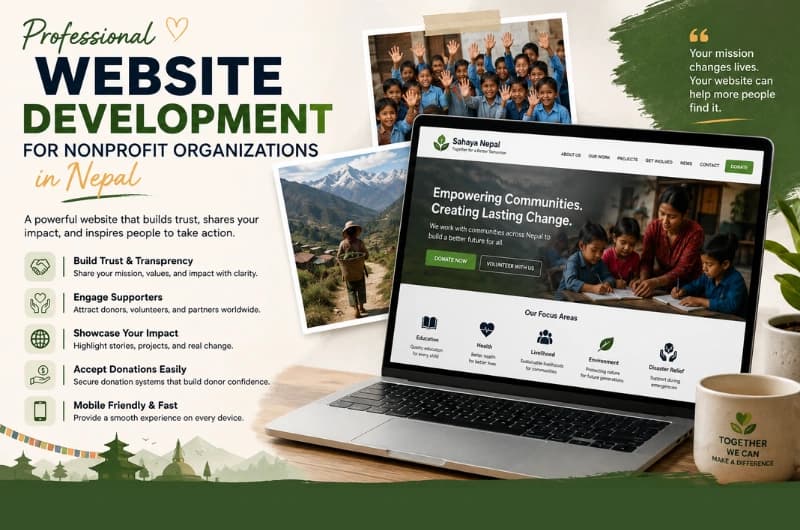
A nonprofit website is more than an online brochure. It is a place where people learn about your mission, see your impact, join your campaigns, volunteer, and make donations.
For NGOs and INGOs in Nepal, a well-designed website can also help build trust with donors, partners, volunteers, beneficiaries, and the wider community. A clear website makes it easier for visitors to understand what your organization does and how they can support your work.
The right nonprofit website features can improve user engagement and make the donation process easier. They can also help your organization share its work with people in Nepal and around the world.
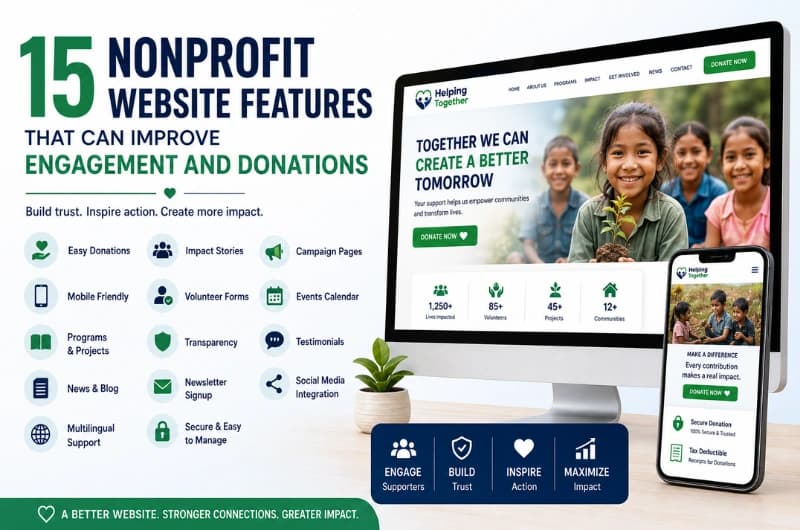
If you are planning a new website or redesigning an existing one, here are 15 nonprofit website features worth including.
Why Nonprofit Website Features Matter

People visit nonprofit websites for different reasons.
A donor may want to know where their money goes. A volunteer may be looking for opportunities. A beneficiary may need information about a program. A partner may want to understand your organization’s work.
Your website should make all of these actions simple.
A strong nonprofit website should help visitors:
- Understand your mission
- Learn about your programs
- See measurable impact
- Donate securely
- Volunteer
- Join events
- Read news and updates
- Contact your team
- Subscribe to updates
- Share your work with others
The goal is not to add every possible feature. The goal is to include the features that support your organization’s mission.
1. Clear and Visible Donation Button
The donation button is one of the most important features on a nonprofit website.
Visitors should not have to search through several pages to find it. Place a clear Donate Now button in the website header and other important areas.
You can also add donation buttons to:
- Homepage
- Campaign pages
- Program pages
- Impact stories
- Blog posts
- Footer
- Donation-related pop-ups when appropriate
Use simple language such as:
Donate Now Support Our Work Make a Difference
Avoid hiding the donation option inside a crowded menu.
Why it improves engagement
A clear call to action tells visitors what they can do next. It reduces confusion and can make the donation journey easier.
2. Simple Online Donation Form
A donation form should be quick and easy to understand.
Ask only for information that you actually need. A long form can discourage people from completing their donation.
A useful donation form may include:
- Donation amount
- One-time or recurring donation option
- Donor name
- Email address
- Payment method
- Optional message
- Donation purpose
Consider offering preset amounts such as:
- NPR 500
- NPR 1,000
- NPR 2,500
- NPR 5,000
- Custom amount
For international donors, you may also need suitable international payment options.
For Nepal-based organizations, payment options should match the audience and the organization’s banking and compliance requirements.
3. Strong Impact Stories
People want to know how their support helps.
Instead of only saying that your organization “helps communities,” show real examples of your work.
For example:
“Your support helped 150 students receive educational materials this year.”
You can use:
- Beneficiary stories
- Before-and-after examples
- Project updates
- Short interviews
- Case studies
- Photo stories
- Video stories
Always protect the privacy and dignity of beneficiaries. Get appropriate permission before publishing names, photographs, or personal information.
Make impact easy to understand
Use simple numbers and facts where they are accurate.
For example:
| Impact Area | Example |
|---|---|
| Students supported | 150 |
| Communities reached | 12 |
| Volunteers involved | 85 |
| Training sessions | 24 |
These figures should be updated regularly so visitors see current information.
4. Dedicated Campaign Pages
Every major campaign should have its own website page.
A campaign page gives visitors one clear place to learn about the problem, understand the solution, and take action.
A good campaign page can include:
- Campaign goal
- The problem
- Your solution
- People or communities being supported
- Progress so far
- Photos or videos
- Donation options
- Volunteer options
- Frequently asked questions
- Campaign updates
For example, an education-focused NGO could create a campaign page for school support, scholarships, or digital learning.
A dedicated page also gives you a URL that can be shared through social media, email, and other marketing channels.
5. Mobile-Friendly Website Design
Many people access websites from smartphones. Your nonprofit website should work well on smaller screens.
A mobile-friendly website should have:
- Easy-to-read text
- Large buttons
- Simple navigation
- Fast-loading pages
- Mobile-friendly donation forms
- Properly sized images
- Easy-to-use menus
A donation form that works well on a desktop but is difficult to use on a phone can create unnecessary friction.
For this reason, mobile-friendly design should be part of the website strategy from the beginning.
Internal link opportunity: Organizations planning a new website can learn more through our [website design in Nepal] page.
6. Volunteer Registration Form
Not everyone can donate money. Many people want to contribute their time and skills.
A volunteer form can make it easier for visitors to get involved.
Your form can ask about:
- Name
- Phone number
- Location
- Areas of interest
- Skills
- Availability
- Previous experience
You can then use this information to match volunteers with suitable programs.
For local NGOs in Nepal, you can also provide volunteer opportunities by city, district, project, or event.
7. Events Calendar
If your organization runs workshops, training sessions, fundraising events, awareness programs, or community activities, an event calendar can be useful.
Visitors should be able to quickly see:
- Event name
- Date
- Time
- Location
- Description
- Registration information
- Contact details
For online events, include the appropriate meeting or registration information.
An event calendar can turn your website from a static information page into an active communication platform.
8. Programs and Projects Section
Visitors should quickly understand what your organization actually does.
Create a dedicated section for your programs and projects.
Each program page can explain:
- What the program does
- Who it supports
- Where it operates
- Why the program is needed
- Key activities
- Results
- Current status
- How people can support it
This structure is especially useful for NGOs and INGOs with multiple projects.
Instead of putting everything on one crowded page, give important programs their own space.
9. Transparency and Financial Information
Trust matters greatly when asking people for donations.
Your website should make important organizational information easy to find.
Depending on your organization and reporting requirements, you can publish:
- Annual reports
- Financial reports
- Project reports
- Audit reports
- Governance information
- Policies
- Registration information
- Donor information
- Program results
A dedicated Reports & Publications section can keep these documents organized.
Transparency does not mean publishing every internal document. It means providing useful information that helps supporters understand how your organization operates.
10. Testimonials and Social Proof
Supporters want to know that your organization is trusted and active.
Testimonials can provide additional context about your work.
You may feature comments from:
- Volunteers
- Donors
- Community members
- Project partners
- Beneficiaries, where appropriate
- Institutional partners
You can also show relevant achievements, certifications, partnerships, awards, or media coverage when these can be verified.
Use genuine testimonials. Avoid creating or exaggerating reviews.
11. News and Blog Section
A blog or news section helps your organization keep supporters informed.
You can publish content about:
- New projects
- Project milestones
- Community stories
- Events
- Volunteer activities
- Research
- Annual reports
- Campaign updates
- Organizational news
Fresh content can also create more opportunities for people to find your organization through search engines.
For example, an NGO working in Nepal could publish articles about education, health, environment, disaster response, women’s empowerment, or other areas related to its mission.
Each article should provide useful information rather than simply promoting the organization.
12. Newsletter Signup
Not every website visitor is ready to donate.
Some visitors may want to learn more first.
A newsletter signup gives you a way to stay connected with them.
You can use newsletters to share:
- Project updates
- Campaign news
- Events
- Volunteer opportunities
- Success stories
- Reports
- Donation campaigns
Keep the signup form simple.
For example:
Get updates from our organization Enter your email address.
Make sure your organization follows applicable privacy and email communication requirements.
13. Social Media Integration
Social media can help nonprofit organizations reach more people.
Add links to your active social media profiles so visitors can follow your organization.
You can also add social sharing buttons to important content such as:
- Campaigns
- Blog posts
- Impact stories
- Events
- Reports
Be selective. Do not add social feeds simply because they are available.
A clean link to an active social profile is often better than adding a large social media widget that slows down the website.
14. Multilingual Content
Nepal has many languages and communities. Depending on your audience, multilingual content can improve accessibility.
For example, an organization working mainly with local communities may benefit from providing important information in Nepali alongside English.
You do not necessarily need to translate every page.
Start with important information such as:
- About the organization
- Programs
- Donation information
- Contact details
- Volunteer information
- Emergency or public service information
Choose languages based on the people your organization serves.
Good translation should be clear and natural, not a direct word-for-word conversion that becomes difficult to understand.
15. Secure, Accessible, and Easy-to-Manage Website
A nonprofit website should be secure, accessible, and easy for staff to update.
This is especially important when the website collects donor, volunteer, subscriber, or contact information.
Security features
Consider:
- HTTPS/SSL
- Secure forms
- Strong administrator passwords
- Regular software updates
- Website backups
- Spam protection
- Secure payment integration
- User access controls
Accessibility features
Your website should also be usable by people with different abilities.
Consider:
- Clear text
- Good contrast
- Descriptive image alt text
- Keyboard-friendly navigation
- Proper heading structure
- Captions for important videos
- Clear form labels
Easy content management
Your team should be able to update basic website content without depending on a developer for every small change.
A suitable content management system can help staff update:
- News
- Events
- Campaigns
- Images
- Reports
- Program information
The Most Important Nonprofit Website Features at a Glance
Here is a quick comparison of the 15 features:
| Feature | Main Purpose | Engagement Impact |
|---|---|---|
| Clear donation button | Encourage donations | High |
| Online donation form | Make giving easier | High |
| Impact stories | Build emotional connection | High |
| Campaign pages | Focus visitor attention | High |
| Mobile-friendly design | Improve mobile experience | High |
| Volunteer form | Attract volunteers | Medium–High |
| Events calendar | Promote activities | Medium |
| Program pages | Explain your work | High |
| Transparency section | Build trust | High |
| Testimonials | Provide social proof | Medium |
| Blog/news | Keep supporters informed | Medium–High |
| Newsletter signup | Build long-term relationships | Medium–High |
| Social media links | Expand reach | Medium |
| Multilingual content | Improve accessibility | Medium–High |
| Security and accessibility | Protect and support users | High |
How to Structure a Nonprofit Website for Better Engagement
Adding features is only part of the job. The website structure also matters.
A simple nonprofit website menu could look like this:
Home | About Us | Programs | Campaigns | Impact | Get Involved | News | Donate | Contact
You can adjust this structure based on your organization’s size and goals.
Homepage structure
A nonprofit homepage can follow this order:
- Clear mission statement
- Primary call to action
- Short introduction
- Key programs
- Current campaign
- Impact numbers
- Success story
- Upcoming events
- Latest news
- Volunteer section
- Donation call to action
- Footer with important links
This gives visitors several ways to engage without making the homepage difficult to use.
Common Nonprofit Website Mistakes to Avoid
Even a website with many features can perform poorly if the basics are ignored.
Avoid these common mistakes:
1. Hiding the donation button
Visitors should not need to search for ways to donate.
2. Using complicated donation forms
Keep the process short and easy.
3. Publishing outdated information
Old project numbers, events, or campaign messages can reduce trust.
4. Using too much text
Break long content into short sections, lists, images, and clear headings.
5. Ignoring mobile users
Test important pages and forms on smartphones.
6. Forgetting website security
A nonprofit website may collect sensitive contact and donor information. Security should be planned from the start.
7. Focusing only on the organization
Talk about your mission, but also explain how visitors can help and what difference their support makes.
8. Making the website difficult to update
Your team should have a practical way to publish new information.
How to Improve Donations Through Better Website Design
Good website design cannot guarantee more donations. But it can remove barriers that make people leave before completing an action.
Focus on these areas:
Make the value clear
Explain what the donation supports.
Reduce distractions
Keep donation pages focused on the action.
Build trust
Show your programs, impact, reports, team, partners, and relevant organizational information.
Make giving easy
Use a simple donation form and suitable payment options.
Show progress
For campaigns, consider showing progress toward a clearly defined goal when the figures are accurate and regularly updated.
Keep the website fast
Large images, unnecessary animations, and poorly optimized plugins can slow down the website.
Test the user journey
Try completing the donation process yourself.
Ask:
- Can I find the donation button?
- Do I understand what my donation supports?
- Is the form easy to complete?
- Does it work on mobile?
- Is the payment process clear?
- Do I receive confirmation?
Small improvements can make the entire experience easier for supporters.
Why Professional Website Design Matters for NGOs and INGOs in Nepal
NGOs and INGOs often need to communicate with different groups at the same time.
Your website may serve donors from other countries, local communities, volunteers in Kathmandu, government agencies, project partners, journalists, and potential employees.
That makes website planning especially important.
A professional nonprofit website should combine:
- Clear design
- Simple navigation
- Mobile responsiveness
- SEO-friendly structure
- Secure forms
- Donation functionality
- Content management
- Accessibility
- Fast performance
- Strong calls to action
For organizations in Nepal, the website should also reflect the local audience while supporting international visitors when required.
Webtech Nepal provides professional website design and development services for organizations and businesses in Nepal. Its website design service covers planning, design, implementation, responsive layouts, and SEO-friendly website development.
If your NGO or INGO needs a new website or wants to improve an existing one, you can explore our [website design in Nepal] page to learn more about our web design services.
How Webtech Nepal Can Help With NGO and INGO Websites
A nonprofit website should be designed around the organization’s goals, audience, programs, and communication needs.
At Webtech Nepal, we can help organizations plan and build websites that include features such as:
- Custom nonprofit website design
- Mobile-responsive layouts
- NGO/INGO program pages
- Campaign landing pages
- Donation functionality
- Volunteer registration forms
- Event management
- News and blog sections
- Content management systems
- Contact and inquiry forms
- SEO-friendly website structure
- Website security
- Website maintenance and support
Webtech Nepal is based in Kathmandu and provides website design and development services for organizations and businesses.
Internal linking opportunity: Add a link from this section to the Webtech Nepal homepage using anchor text such as Webtech Nepal.
If you are planning an NGO or INGO website, you can also contact Webtech Nepal for web design services and discuss your project requirements, pages, features, and budget before development begins.
Frequently Asked Questions
What features should a nonprofit website have?
A nonprofit website should ideally have a clear donation button, online donation form, program pages, impact stories, campaign pages, volunteer registration, events, news, transparency information, contact forms, and mobile-friendly design.
How can a nonprofit website increase donations?
A website can make donations easier by using a clear call to action, a simple donation form, secure payment options, strong trust signals, clear information about the organization’s impact, and an easy mobile experience.
Should an NGO website have a donation page?
Yes. If your organization accepts donations, a dedicated donation page can make it easier for supporters to understand the giving process and complete their contribution.
Should NGO websites be mobile-friendly?
Yes. A nonprofit website should work well on smartphones, tablets, and computers. Important actions such as donations, registrations, and contact forms should be easy to complete on smaller screens.
What should an NGO put on its homepage?
An NGO homepage should clearly explain its mission, highlight important programs, show current impact, feature active campaigns, provide ways to get involved, and include a visible donation call to action.
Should an NGO publish annual reports online?
Publishing relevant annual and project reports can help improve transparency and give supporters more information about the organization’s work and results.
Can Webtech Nepal develop websites for NGOs and INGOs?
Yes. Webtech Nepal provides website design and development services for organizations and can build websites based on their content, programs, audience, and required functionality.
How much does an NGO website cost in Nepal?
The cost depends on the website’s size, design requirements, number of pages, content management system, donation features, integrations, and other custom functionality. The best approach is to discuss your requirements with a web development company and request a project-specific quotation.
Conclusion
The best nonprofit website is not simply the one with the most features. It is the one that makes it easy for people to understand your mission and take action.
Features such as online donations, impact stories, campaign pages, volunteer forms, mobile-friendly design, transparency information, and clear calls to action can help your organization create stronger connections with supporters.
If you are planning a new NGO or INGO website in Nepal, start with your audience and goals. Then choose the features that make those goals easier to achieve.
For professional website design in Nepal, Webtech Nepal can help you plan and develop a nonprofit website that is clear, responsive, secure, and easy to manage.
Ready to build or redesign your NGO/INGO website? Contact Webtech Nepal to discuss your web design requirements and create a website that helps your organization connect with more people.